
XIAMEN ACEY NEW ENERGY TECHNOLOGY CO., LTD.

How Do You Choose a Battery Cell Sorting Machine? Channels, Cell Format and OCV/IR Testing
November 26 , 2026
A cell sorter does one job: it measures each cell's open-circuit voltage and AC internal resistance, then drops it into the right bin. It is faster than a capacity tester and it does a different thing. If you are trying to work out how many channels you need, or why one machine handles 18650s and another takes pouch cells, those are the questions worth answering before you ask for a quote.
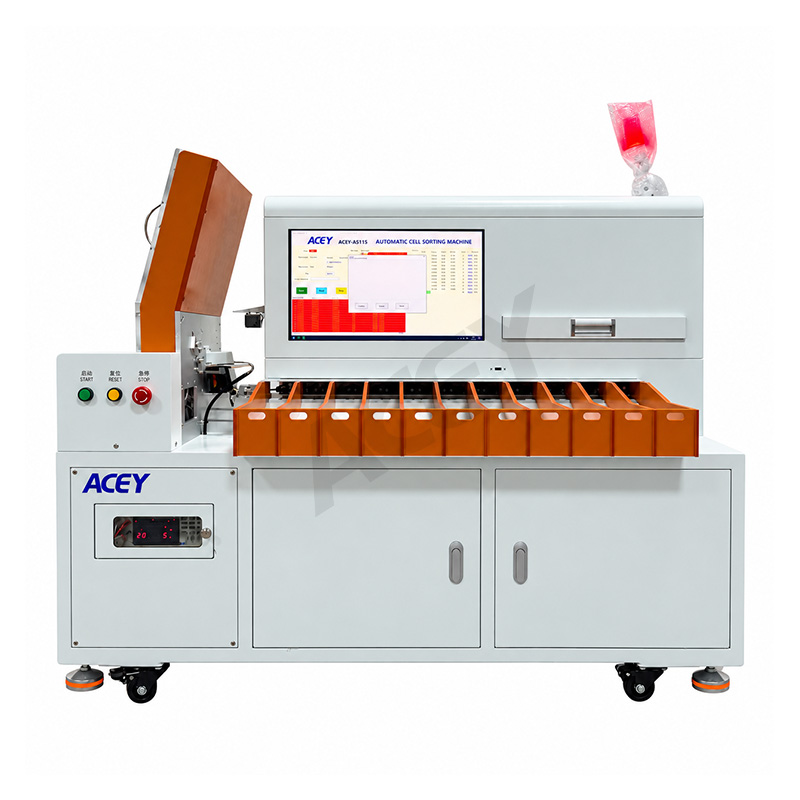
Sorting is a quick electrical check, not a capacity test. The cell goes onto a test station, the machine reads its open-circuit voltage and AC internal resistance, and those two numbers decide which bin it lands in. There is no charge-discharge cycle, so a sorter can process thousands of cells an hour where a capacity grading system cannot.
That distinction matters when you are building a pack. Cells in a series group need to start at similar voltage and similar resistance, and a sorter is the machine that makes those groups. Capacity grading is a separate, slower step that comes before it. Buying a sorter expecting it to report capacity will leave you disappointed.
Automatic sorters are split by cell format. The cylindrical group uses a hopper and feeding chute; the prismatic group handles rectangular cells with mechanical handling; the pouch group conveys soft cells through grade lanes. The cylindrical cell sorting machines are not interchangeable with the other two.
There is one exception worth knowing. A manual OCV and internal resistance tester, the ACEY-MS03, is built to accept cylindrical, prismatic and pouch cells on the same machine, and supports up to ten grading parameter settings. For a lab or a pilot line that switches formats, that is a different kind of purchase from an automatic line sorter.
| Group | How cells are fed | Typical cell sizes |
|---|---|---|
| Cylindrical | Hopper and feeding chute. | 14650, 18650, 21700, 26650, 32700, 32140, 33140. |
| Prismatic | Manual loading or mechanical handling, with code scanning. | Rectangular cells; one model takes 90–300 mm length, 12–85 mm width. |
| Pouch | Transfer and conveyor into individual grade lanes. | Polymer and lithium pouch cells for EV, storage and 3C. |
This is the most common reading error in a spec sheet. An "11-channel" sorter usually has ten sorting bins and one reject channel. The ACEY-AS11S parameter table spells it out: 10 sorting and matching group channels, 1 unqualified product channel. The ACEY-AS5S is 4 plus 1, and the ACEY-AS6S is 5 plus 1.
So if you need eight usable grades, an eight-channel machine will not give you eight grades — check whether the NG bin is counted in the headline number. Per-bin sorting values can be set freely on most models, which is how one machine covers different matching rules.
| Machine | Headline channels | Sorting + reject |
|---|---|---|
| ACEY-AS11S | 11 | 10 sorting + 1 NG |
| ACEY-AS6S / AS6SP | 6 | 5 sorting + 1 NG |
| ACEY-AS5S | 5 | 4 sorting + 1 NG |
| ACEY-PSLC10 | 10 | 9 OK + 1 NG |
| ACEY-PCSM5 | 5 | 4 grade lanes + 1 reject |
The AS11S is the high-throughput end of the cylindrical range. It takes 14650, 18650, 21700, 26650 and 32700 cells, runs at up to 4800 cells per hour, with some configurations quoted at 5000 pcs per hour, and can change over in roughly 15 minutes. An industrial camera reads QR or barcode codes on some versions so each result is tied to a cell.
Smaller operations usually land on the AS5S or AS6S. Both sort voltage and internal resistance on 18650, 21700, 26650, 32650 and 32700 cells, with a touch screen for operation. The AS10S is the one to look at for 32140 and 33140 cells — it uses a HIOKI3561 tester and runs at 80 ppm with a 9-plus-1 channel layout.
One variant combines two steps. The ACEY-SS11 applies an insulating paper ring, performs the electrical tests and sorts, at up to 4800 cells per hour. The paper pasting unit and the sorter can also run independently if the process needs them apart.
Prismatic cells are bigger and heavier, so throughput is lower and handling matters more. The ACEY-PS3S does three levels of sorting at about 600 cells per hour with an HK3560 internal resistance tester. The ACEY-PS8 uses a HIOKI BT3562A and also runs around 600 pieces per hour, with voltage, internal resistance and group information managed in the software.
Where traceability matters, the ACEY-PS6 adds an industrial camera for QR and barcode reading, linking the cell's identity to its test result. It uses manual loading by servo-driven inspection and sorting, with five OK grades and one NG grade. Internal resistance testers of different brands can be fitted to meet a required measurement accuracy.
The prismatic cell sorting machines group also includes a model that cleans as it sorts. The ACEY-PSLC10 removes oxide layers and contaminants from terminals with a 200W MAX pulsed laser after the OCV and IR test, ahead of assembly. One machine, two process steps.
| Model | Tester / feature | Output |
|---|---|---|
| ACEY-PS3S | HK3560 IR tester, 3 levels. | About 600 cells/hour. |
| ACEY-PS8 | HIOKI BT3562A, data analysis and export. | About 600 cells/hour. |
| ACEY-PS6 | QR/barcode camera, 5 OK + 1 NG. | Manual loading, servo sorting. |
| ACEY-PSLC10 | 200W laser terminal cleaning, 9 OK + 1 NG. | Continuous line operation. |
| ACEY-PCS10-FIO | Robotic arms, detection accuracy ±0.01 mm. | 500–600 units/hour. |
Soft cells do not tumble through a hopper. The pouch cell sorting machines transfer each cell, test it, scan its code and send it down a conveyor lane. The ACEY-PCSM5 uses a Hioki BT3561A to measure open-circuit voltage and AC internal resistance in the same test cycle, sends cells to one of four grade lanes or a dedicated NG lane, and runs at up to 1000 pouch cells per hour. Upper and lower limits for voltage and resistance are set per grade.
The ACEY-PCSM6 combines manual loading, testing, barcode scanning and sorting at the same 1000 pcs per hour. The ACEY-PCSM is offered as a seven-channel version, and other listings in this group cover polymer lithium cells for power batteries, 3C digital batteries and energy storage.
Roughly 1000 cells an hour sounds slow next to a cylindrical sorter doing 5000. It is not a fault — the cells are larger, softer and handled one at a time. Compare throughput inside a format group, not across groups.
Most of the accuracy comes from the internal resistance tester fitted inside, not from the frame around it. HIOKI units appear repeatedly: BT3561A on the barcode-equipped AS11S and on the five-channel pouch sorter, HIOKI3561 on the AS10S and AS6S, BT3562A on the PS8. Lower-cost listings use HK3560 or HK3561. All of them measure the same two quantities; they differ in precision and speed.
If matching quality is critical, the tester brand is a specification worth pinning down in the quotation. "High-precision internal resistance tester" on its own does not tell you much.
| Internal resistance tester | Machines fitted with it | Cell group |
|---|---|---|
| HIOKI BT3561A | AS11S with barcode scanner; PCSM5. | Cylindrical, pouch. |
| HIOKI3561 / HK3561 | AS10S; AS6S. | Cylindrical. |
| HIOKI BT3562A | PS8. | Prismatic. |
| HK3560 | PS3S. | Prismatic. |
Entry-level sorters run on a PLC with a touch screen. Higher-throughput models move to a PC plus motion controller and servo motors, which allows data analysis, storage and report export alongside the sorting itself. The AS11S, for example, combines PC-based control, a motion controller, precision servo motors and a HIOKI BT3561A to handle feeding, testing, sorting and collection in one system.
That matters less than it sounds if nobody uses the data. It matters a great deal if you need to review a batch later or feed results into a production system. Servo drive also shows up in the speed difference between the AS5S and the AS5SP: the latter is specified at around 3200 pcs per hour on a PC-based architecture.
Traceability is either built in or it is not. Some machines scan a code and link the test result to that specific cell; others only report a grade count. The AS11S with barcode scanner supports QR and barcode reading, separate reject collection and MES connectivity. The PS6 links cell identification to recorded results through its industrial camera. The PCSM5 sends results to individual cell codes.
On the AS10SP-33140, barcode and QR scanning is listed as optional rather than standard — a detail worth checking before you assume the data will be there. If the downstream pack line records cell identities, specify the scanning function explicitly.
| Model | Data handling | Speed figure |
|---|---|---|
| ACEY-AS11S | Barcode/QR, MES, data storage and reports. | Up to 4800–5000 cells/hour. |
| ACEY-AS5SP | MES integration, PC control. | About 3200 pcs/hour. |
| ACEY-PCSM5 | Results linked to individual cell codes. | Up to 1000 cells/hour. |
| ACEY-AS10SP-33140 | MES integration; barcode/QR optional. | Up to 3200 cells/hour. |
Not every line justifies an automatic hopper. The ACEY-MS01 is a manual OCV and IR sorting machine for prismatic and cylindrical cells: an internal resistance tester measures and records the two values and the grading result appears on the screen. The ACEY-MS03 goes further by accepting cylindrical, prismatic and pouch cells on one machine, with support for up to ten grading parameter settings.
These suit battery manufacturers, laboratories and pilot lines that need multi-format testing without dedicating a full machine to each cell shape. They will not replace a 5000-per-hour line sorter, and they are not meant to.
Vision inspection sits outside the sorting group. A CCD tester checks whether cells are placed with the correct polarity in a series-parallel pack and whether spot welds have defects — it is looking at the assembled pack, not measuring OCV and resistance to create matching groups.
The ACEY-CCD-1 detects reversed polarity and spot-weld defects on cylindrical packs. The ACEY-CCD01 handles cell sizes including 14430, 14500, 18500, 18650, 21700, 26650, 32650 and 32700, with a detection range of 400 by 300 mm and a stated speed of 100 cells in 1.5 seconds. The ACEY-CCD01C adds a failed-return mechanism so NG packs can be corrected and re-tested.
No. It measures open-circuit voltage and AC internal resistance and groups cells by those two values. Capacity grading uses a charge-discharge tester and takes longer. The two steps are separate in a pack production line.
Automatic sorters are format-specific: cylindrical machines feed through a hopper, prismatic machines handle rectangular cells and pouch machines use grade lanes. A manual OCV and IR tester such as the ACEY-MS03 does support all three formats on one unit, but at manual throughput.
Cell format and handling method drive the difference. Cylindrical sorters reach 3200 to 5000 cells per hour, pouch sorters around 1000, and many prismatic models about 500 to 600. Compare figures within the same format group rather than expecting one number across all machines.
Rm703, No.223, Qishan North Road, Huli District, Xiamen, Fujian, China
Email : allen@xmacey.com
Tel : +8618950009155
Whatsapp : +8618950009155